TL;DR
A 10x30x2 filter fits where a 10x30x1 used to go only if your filter slot has at least 1.75 inches of clear depth. Both sizes share the same 9.5 x 29.5-inch face, but the 10x30x2 is a full inch thicker, at 1.75 inches actual versus 0.75. Measure the inside depth of your filter track before you order. If it's under 1.75 inches, stay with the 10x30x1.
Both sizes are cut on U.S. production lines, and depth is the dimension the manufacturing team sees ordered wrong more than any other. Most slots built for one-inch filters can't take the extra inch, so this page starts with one number: your slot's clear depth.
Key Takeaways
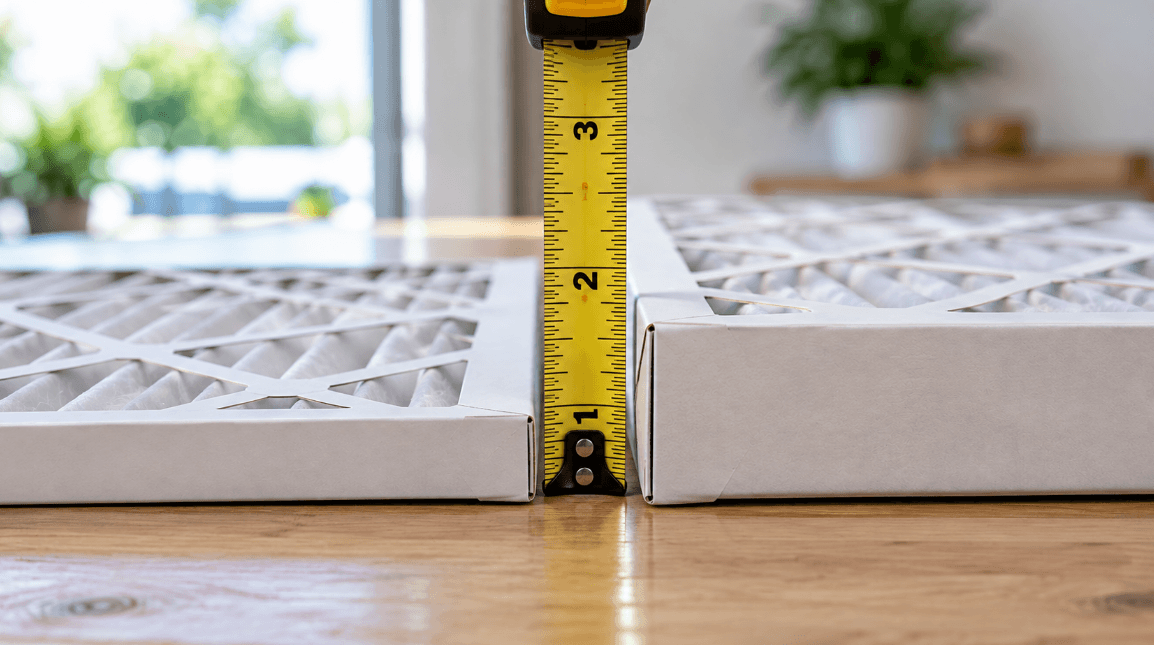
• A 10x30x1 measures 9.5 x 29.5 x 0.75 inches, and a 10x30x2 measures 9.5 x 29.5 x 1.75 inches. Only the depth changes.
• Measure the slot, not the old filter. The old filter shows what fit before, not what could fit now.
• Never force, bend, or trim a filter. Once it bows or gaps, unfiltered air slips past it.
• Depth and MERV rating are separate choices. A thicker filter isn't automatically a more efficient one.
• A two-inch filter's main advantage is dust-holding capacity and longer change intervals. Lower airflow resistance isn't guaranteed.
What Is the Difference Between a 10x30x1 and a 10x30x2 Filter?
A 10x30x1 and a 10x30x2 differ only in depth. Filterbuy, a Talladega, Alabama–based manufacturer of pleated HVAC air filters, lists its 10x30x2 filter at 9.5 x 29.5 x 1.75 inches and its 10x30x1 filter at 9.5 x 29.5 x 0.75 inches.
The "1" and "2" in each name are nominal labels. We cut every two-inch filter a quarter inch short on purpose so it slides into the track without binding. That sets the real test for your slot: it needs at least 1.75 inches of clear depth, not a full 2 inches.
Can You Put a 2-Inch Filter in a 1-Inch Slot?
Usually not. A slot built for 1-inch filters has roughly an inch of clear space, and a 10x30x2 won't seat in it.
Forcing one in causes three problems. The access door or return grille won't latch, the frame bows, and gaps open along the edges so air bypasses the media. The EPA's Guide to Air Cleaners in the Home says a filter should fit snugly, with no air leaking around it and no bending or crushing to make it fit.
How Do You Measure a Filter Slot's Depth?
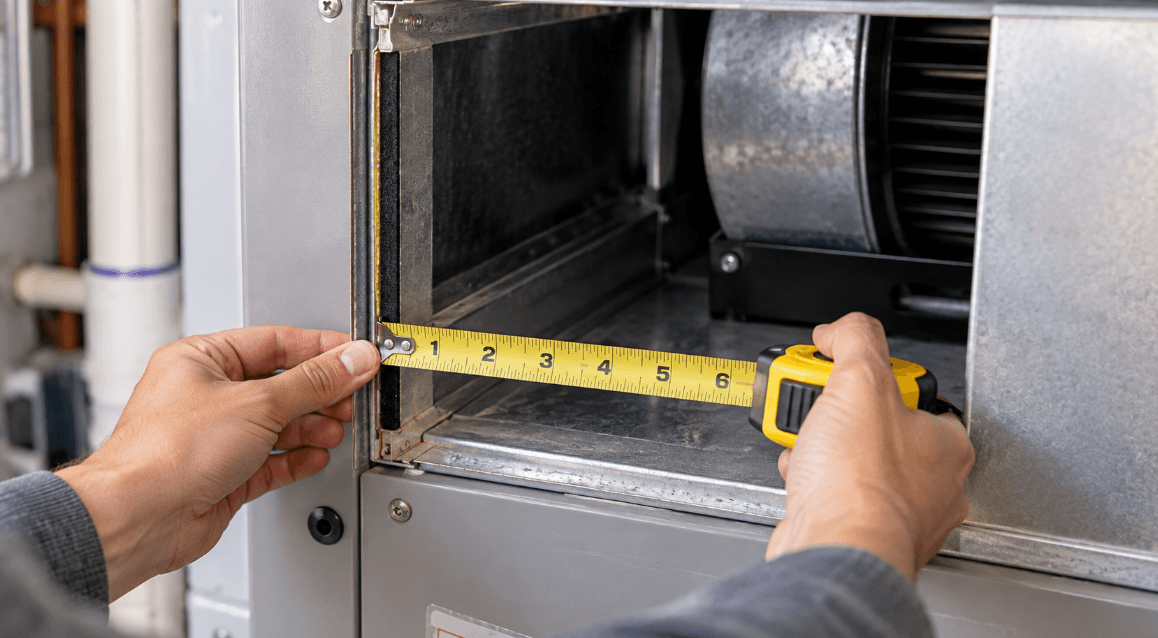
Measure the inside of the filter track, not the old filter. You need a tape measure and about two minutes. If you can't find the slot, Start with this guide to where your HVAC air filter is located.
1. Turn the system off at the thermostat.
2. Remove the old filter and note its printed size and airflow arrow direction.
3. Measure the track's inside depth at two or three points, rail to rail or front edge to back stop.
4. For a hinged return grille, measure from the grille door to the filter frame's back stop.
5. Confirm the opening fits a 9.5 x 29.5-inch face.
For photos and more sizing examples, see this guide on how to measure your air filter.
Which Size Should You Order?
Order by your clear-depth measurement:
1. 1.75 inches or more: Order the 10x30x2 air filter. It will seat fully and seal.
2. About 0.75 to 1 inch: Stay with the 10x30x1.
3. Between 1 and 1.75 inches: Stay with the 10x30x1 and check the seal. A 0.75-inch filter can shift in a deeper track, so run a hand around the edges with the system on. If you feel air, ask a technician about fixing the rack.
4. Numbers that don't match either size: Measure the slot opening and consider a custom-cut filter.
Is Upgrading to a Thicker Furnace Filter Worth It?
Upgrading to a 10x30x2 is often worth it if your slot allows it, mainly because deeper pleats hold more dust before the filter needs changing. Research on depth and airflow resistance is mixed (see Supporting Statistics), so don't count on depth alone. Allison Bailes of Energy Vanguard reviewed a Home Energy study that found little pressure-drop difference between 1-inch and 4-inch filters at the same MERV, and his broader guidance is that face area matters more than depth.
Our take for 10x30 slots: a 10x30 has roughly 1.95 square feet of actual face. Bailes's rule of thumb calls for at least 2 square feet per 400 cfm of airflow, so one 10x30 suits roughly one ton of cooling. Going to two inches adds dust capacity but no face area. If a 10x30 is the only return on a larger system, the fix is a second return or a bigger grille, and that's a job for a technician.
Once your track clears 1.75 inches, choose 10x30x2 pleated filters with a 1.75-inch actual depth and pick a MERV rating separately:
• MERV 8 for everyday dust.
• MERV 11 for pollen and pet dander.
• MERV 13 for smoke and finer particles. The EPA recommends MERV 13, or the highest rating your system fan and slot can handle.
Does a 2-Inch Filter Cost More to Run?
A 10x30x2 costs more per filter but can cost less per year if it lasts longer in your home.
• 10x30x1: $9.16 each, changed every 60–90 days, comes to about $37–$55 a year.
• 10x30x2: $11.66 each, changed every 3 months, comes to about $47 a year, or about $23 if inspections let you stretch it to 6 months.
Check the filter monthly and change it when it looks loaded. Prices change, so confirm current pricing on the product pages.
What Should You Do If a 10x30x2 Won't Fit?
If a 10x30x2 won't fit, stay with the 10x30x1. A one-inch filter that seals does more for your system than a thicker one that doesn't. We've heard from thousands of customers who tried a "close enough" size first, and air usually finds the gaps around the frame.
Don't stack two one-inch filters to fake the depth, since two layers add resistance without the benefits of a purpose-built two-inch filter. For a permanent upgrade, ask an HVAC technician these questions:
1. Can you measure static pressure with my current filter in place?
2. Can my filter rack or return grille be modified for a 2-inch filter?
3. Would a second return help airflow more than a thicker filter?
4. Which MERV rating can my blower handle without losing airflow?
Essential Resources on 10x30x2 Air Filters
1. Confirm the Exact 10x30x2 Size and MERV Options
Filterbuy's 10x30x2 product page lists the filter's actual size, 9.5 x 29.5 x 1.75 inches, and its MERV 8, 11, and 13 options. Start here to confirm how much depth your slot needs.
Source: Filterbuy: 10x30x2 Air Filters
2. Compare MERV Ratings on Federal Data
The EPA's MERV explainer shows the minimum share of particles each rating must capture across three size ranges, from 0.3 to 10 microns. Use it to compare MERV 8, 11, and 13 on test data rather than packaging claims.
Source: U.S. EPA: What Is a MERV Rating?
3. Check the EPA's Rules for Choosing and Fitting a Filter
The EPA's consumer guide notes that home filters come 1 to 5 inches thick and must fit without leaks or bending. It also advises asking an HVAC technician before moving to a higher-efficiency filter.
Source: U.S. EPA: Guide to Air Cleaners in the Home
4. Install a Filter the Way DOE Building Experts Recommend
The Department of Energy's Building America guide explains where filters belong and why the slot cover must seal. It also warns against using a higher MERV than your system was designed for.
5. Keep to ENERGY STAR's Filter Schedule
ENERGY STAR recommends checking your filter every month and changing it at least every three months.
Source: ENERGY STAR (EPA and DOE): Heat & Cool Efficiently
Supporting Statistics
1. Filters Cause 20–50% of an HVAC System's Airflow Resistance
The California Energy Commission reports that air filters typically account for 20 to 50 percent of total HVAC system pressure drop, depending on the system and how loaded the filter is. A study it cites estimated that up to 85 percent of systems run filters with excessive pressure drop.
Source: California Energy Commission, Final Staff Report on Air Filters (CEC-400-2021-014)
2. MERV 10–13 Upgrades Changed Blower Energy by Less Than 5%
Lawrence Berkeley National Laboratory monitored forced-air systems in 10 California homes for at least a year each. Moving to MERV 10–13 filters had a moderate effect on blower energy, under 5 percent, while MERV 16 filters raised it by about 20 percent in some systems. Among MERV 16 filters, 4-inch versions had less pressure drop than 1-inch versions.
3. MERV 13 Captures at Least 50% of the Finest Particles Tested
The EPA's rating table requires a MERV 13 filter to capture at least 50 percent of particles from 0.3 to 1.0 microns and at least 85 percent from 1.0 to 3.0 microns. MERV 8 has no requirement below 1.0 micron.
Source: U.S. Environmental Protection Agency, What Is a MERV Rating?
Final Thoughts
Whether a 10x30x2 can replace your 10x30x1 comes down to one number: the clear depth of your slot. At 1.75 inches or more, the thicker filter holds more dust and may stretch your change interval. Below that, a well-sealed 10x30x1 is the better filter for your system.
Next Steps
1.Measure your filter track's clear depth using the steps above.
2.Use the decision guide to choose a 10x30x1, a 10x30x2, or a custom size.
3.Pick a MERV rating that fits your household and your system's limits.
4.Set a monthly reminder to check the filter.
Frequently Asked Questions
Can I use a 1-inch filter in a 2-inch slot?
No. A 1-inch filter leaves roughly an inch of empty space in a 2-inch track, and air can slip around it. Use the depth your slot was built for.
Is a 10x30x2 filter actually 2 inches thick?
No. 10x30x2 pleated air filter measures 9.5 x 29.5 x 1.75 inches. Two-inch filters are cut a quarter inch short so they slide in without forcing.
Will a 2-inch filter lower my energy bill?
Probably not by much. Lawrence Berkeley National Laboratory found MERV 10–13 filters had small energy effects in most homes. Changing any filter before it clogs matters more.
Can I put a 10x30x2 in a wall or ceiling return grille?
Only if the grille's filter frame is at least 1.75 inches deep. Many return grilles are built for 1-inch filters, so open the grille door and measure behind it first.
Can I trim or bend a filter to fit?
No. Trimming or bending breaks the frame's seal and damages the media, so air goes around the filter instead of through it.
Shop 10x30x2 Air Filters
If your slot clears 1.75 inches, shop Filterbuy's 10x30x2 air filters in MERV 8, 11, or 13. They're made in the USA and ship within 24 hours, with lower per-filter pricing on multipacks.
Learn more about HVAC Care from one of our HVAC solutions branches…
Filterbuy HVAC Solutions - West Palm Beach FL
1655 Palm Beach Lakes Blvd., Ste 1005 West Palm Beach, FL 33401
(561) 448-3760
https://maps.app.goo.gl/VarpgNZnxuPQuW8A7